
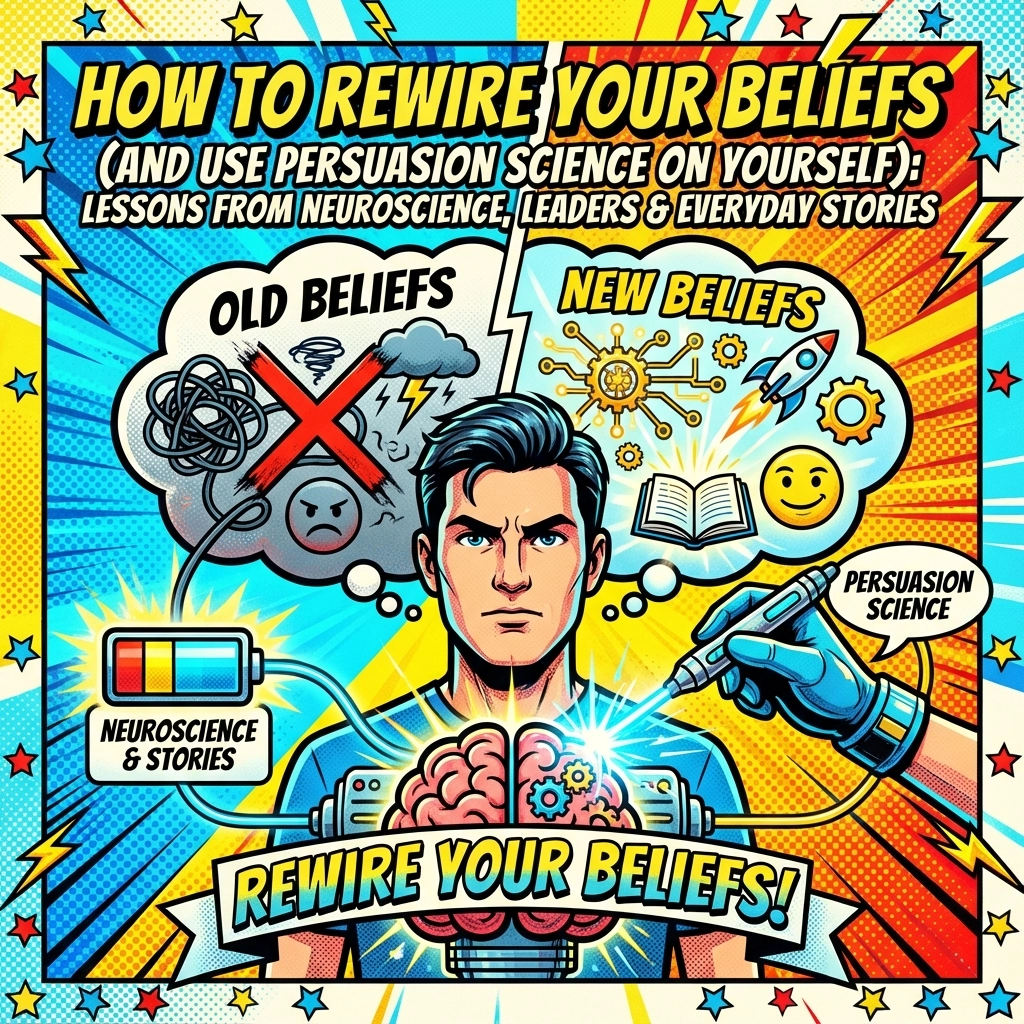
Think about this: the same psychological techniques that politicians use to sway millions, that cult leaders use to control followers, and that master persuaders use to influence decisions: these exact same tools can be turned inward to transform your own life.
The difference? Instead of manipulating others, you’re empowering yourself.
Chase Hughes and other behavioral experts have spent years dissecting how belief change really works. The fascinating part isn’t just understanding how others influence us: it’s realizing we can use these scientifically-backed methods to break free from our own mental prisons and build the beliefs that actually serve us.
The Brain Science That Changes Everything
Here’s what neuroscience tells us: your brain is literally rewiring itself every moment of every day. This process, called neuroplasticity, means that the neural pathways supporting your current beliefs aren’t permanent fixtures: they’re more like hiking trails that get stronger with use and fade when abandoned.
Dr. Donald Hebb discovered the fundamental principle behind this: “Neurons that fire together, wire together.” Every time you think a thought, your brain strengthens the neural connections associated with that thought. Think it enough times, and it becomes an automatic highway in your mind.
But here’s the kicker: this works for both empowering and limiting beliefs.

The research is clear: through consistent practice, you can literally sculpt your brain to support new ways of thinking. Studies using fMRI and PET scans show that techniques like visualization, positive self-talk, and cognitive reframing create measurable changes in brain structure and activity.
Real People, Real Transformations
Take Jim Carrey, who famously wrote himself a $10 million check for “acting services rendered” when he was broke and unknown. He carried that check in his wallet and visualized his success daily. While it sounds like wishful thinking, Carrey was unknowingly using neuroplasticity to rewire his beliefs about what was possible for his career. By the time the check’s date arrived, he had landed his breakthrough role in “Dumb and Dumber”: for exactly $10 million.
Or consider Sara Blakely, who turned a simple idea for footless pantyhose into Spanx, a billion-dollar empire. She credits her success to a daily practice her father taught her: celebrating failures. Every dinner conversation included sharing their daily failures, reframing setbacks as learning opportunities. This constant mental reframing literally rewired her brain to see obstacles as stepping stones rather than roadblocks.
But transformation isn’t just for celebrities. I recently heard about Maria Santos, a single mother from Detroit who used these principles to escape poverty. After losing her job during the pandemic, instead of succumbing to despair, she started each morning by writing down three things she was grateful for and visualizing herself succeeding in a new career. She studied coding online, constantly telling herself “I am capable of learning this.” Eighteen months later, she landed a six-figure tech job. Her secret? She systematically replaced her “I’m not smart enough” belief with “I’m constantly learning and growing.”
Your Step-by-Step Belief Transformation Toolkit
Step 1: Identify Your Target Belief
Start by getting brutally honest about what’s holding you back. Write down the limiting belief exactly as it shows up in your head. “I’m not good enough,” “Success isn’t for people like me,” “I always mess things up.”
Then craft your replacement belief. Make it believable and specific. Instead of “I’m amazing,” try “I’m capable of learning and improving every day.” Your brain needs to buy into the new belief, or it’ll reject it outright.
Step 2: Use the “Fire Together, Wire Together” Principle
This is where the magic happens. You need to repeatedly activate your new belief pattern through multiple techniques:
Visualization with Emotion: Spend 5-10 minutes daily vividly imagining yourself living your new belief. See yourself succeeding, feeling confident, taking action. The key is emotion: your brain pays attention to what feels important.
Affirmation with Conviction: Say your new belief out loud with genuine emotion. “I am becoming more confident every day.” Don’t just mumble it: feel it.
Cognitive Reframing: Whenever your old belief pops up, immediately counter it with your new one. Make this non-negotiable.

Step 3: Create Environmental Triggers
Change your environment to support your new belief. If you’re working on confidence, stand differently, dress better, choose music that makes you feel powerful. Your brain associates beliefs with everything around you, so use that to your advantage.
Step 4: Practice Mental Rehearsal
Before challenging situations, mentally rehearse responding from your new belief system. Athletes use this technique to improve performance, and you can use it to strengthen new thought patterns.
The Neuroscience of Habit Formation
Dr. Ann Graybiel’s research at MIT reveals that habit formation happens in a specific brain region called the basal ganglia. When you consistently practice new thought patterns, this region starts automating them, making positive thinking as unconscious as breathing.
The process typically takes 66 days on average, according to Dr. Phillippa Lally’s research at University College London. But here’s what most people don’t know: the strongest habits form when you attach them to existing routines.
For example, if you want to build a confidence habit, link your affirmations to something you already do automatically: like drinking your morning coffee or brushing your teeth.
Breaking Through the Resistance
Your brain will fight back. That’s normal and expected. Dr. Rick Hanson explains this as your brain’s “negativity bias”: a survival mechanism that makes us focus on threats and problems.
When resistance hits, remember this story: Nick Vujicic was born without arms or legs, facing a life that seemed destined for limitation and despair. In his teens, he struggled with depression and even attempted suicide. But he made a conscious decision to reframe his narrative from “victim of cruel fate” to “inspiration for others facing challenges.”
He systematically replaced thoughts of “I can’t” with “I’ll find a way.” Today, he’s a internationally sought-after motivational speaker who has inspired millions. His transformation didn’t happen overnight: it was the result of consciously choosing empowering beliefs and reinforcing them daily through action and self-talk.

The key insight: resistance isn’t a sign you’re failing: it’s proof the process is working. Your old neural pathways are fighting to stay relevant.
Beyond Personal Change: The Ripple Effect
Here’s something beautiful about belief transformation: it’s contagious. When you change your internal narrative, you unconsciously give others permission to change theirs.
Consider Malala Yousafzai, who transformed her trauma from the Taliban attack into an unshakeable belief that education could change the world. Her reframed narrative: from victim to advocate: didn’t just transform her life; it inspired a global movement.
Or think about everyday heroes like teachers who refuse to accept that any child is “unteachable,” or community organizers who believe neighborhoods can be transformed one person at a time. Their unwavering beliefs create ripple effects that touch hundreds of lives.
Making It Stick: The Long Game
Real belief change isn’t about positive thinking: it’s about evidence-based thinking. As you practice your new beliefs, you’ll start noticing evidence that supports them. You’ll speak up in meetings, take calculated risks, or handle rejection better. Each small success becomes proof that your new belief is true.
The compound effect is incredible. Small daily practices of empowering self-talk, visualization, and reframing accumulate into fundamental shifts in how you see yourself and what you believe is possible.
Remember: the same psychological principles that move masses can move you. The same brain science that creates influence can create internal transformation. You’re not just along for the ride in your own mental life; you’re the pilot.
Start today. Pick one limiting belief, craft its empowering replacement, and begin the daily practice of rewiring your brain. Your future self is counting on it.
The vault of your potential is already there. Now you have the combination to open it.